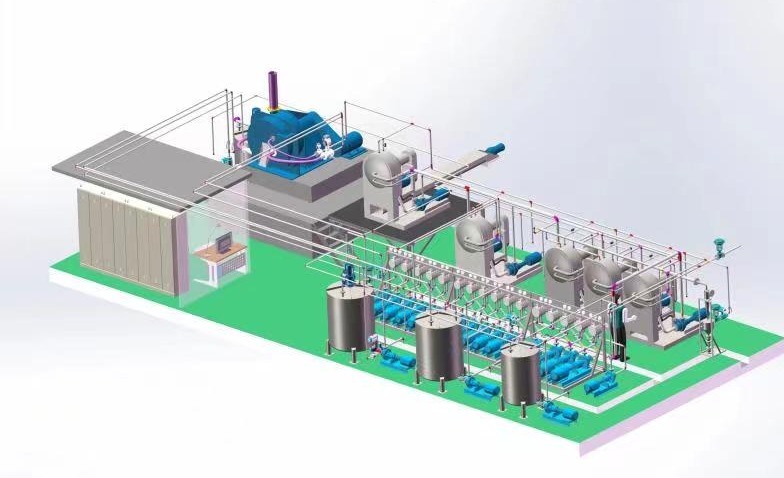

Analysis of Central Asia Starch Processing Equipment Market
The starch processing technology equipment market in Central Asia (including Kazakhstan, Uzbekistan, Tajikistan, Kyrgyzstan and Turkmenistan) is gradually expanding with the development of agricultural modernization and food processing industry. The following is a comprehensive analysis of the market:
1. Market background and demand drivers
Rich in agricultural resources: Central Asia is the world's major producing area of wheat, corn, and potatoes (especially Kazakhstan and Uzbekistan), providing a raw material base for starch processing.
Growth in the food processing industry: With population growth and urbanization, demand for starch derivatives (such as candies, dairy products, convenience foods) has increased, driving demand for efficient processing equipment.
High import dependence: The local equipment manufacturing industry is weak and mainly relies on imports (China, Europe, Turkey). China's equipment accounts for a large share due to its cost-effective advantages.
Policy support: Countries encourage deep agricultural processing through subsidies or tax incentives, such as Uzbekistan's Agricultural Modernization Plan 2020 - 2030.
2. Analysis of major market countries
Kazakhstan
Largest market: The economy accounts for more than 60% of Central Asia, and starch processing is concentrated in cities such as Almaty and Nursultan.
Demand characteristics: tend to large-scale automation equipment, China enterprises such as "COFCO Engineering" have participated in local projects.
Uzbekistan
Rapid growth: The government has made starch processing the focus of increasing the added value of agricultural products, and the demand for potato starch production lines is significant.
Challenges: Infrastructure such as electricity is insufficient, and small and medium-sized equipment is more popular.
other countries
Tajikistan/Kyrgyzstan: Small market, but great potential, suitable for small modular equipment.
Turkmenistan: Policies are closed, but cotton by-product processing may bring opportunities.
3. Technical equipment demand trend
Mainstream equipment types: cleaning machines, crushers, centrifuges, dryers, packaging lines.
Technology upgrade direction:
Energy conservation and environmental protection: Water shortage drives the demand for wastewater recycling equipment.
Automation: Rising labor costs are driving the popularization of PLC control systems.
Multifunctionality: Integrated equipment that can process multiple raw materials (such as corn and potatoes) is popular.
4. competition pattern
Main suppliers:
China: Obvious price advantages (such as Henan Feichi and Shandong Jujin), occupying the mid-to-low-end market.
Europe: German (such as GEA) and Dutch companies dominate the high-end market, but prices are high.
Local enterprises: Most of them are agents or small maintenance service providers and lack manufacturing capabilities.
Procurement channels: Connect through international exhibitions (such as Kazakhstan Agricultural Exhibition) or B2B platforms (such as TradeKey).
5. Market entry advice
Cooperation model:
Build a joint venture with a local agricultural group (such as the "Astana Group" in Kazakhstan).
Provide financial leasing services and lower customer procurement thresholds.
Key success factors:
Flexible configuration adapted to small-scale production.
After-sales service system (spare parts supply, technical training).
Risk warning:
High logistics costs (Central Asia inland transportation).
Exchange rate fluctuations (e.g., Kazakhstan tenge).
6. future prospects
CAGR is expected to be about 8 - 10% from 2025 to 2030, with Uzbekistan and Kazakhstan as the core growth.
Potential opportunities: Long-term demand for processing equipment for biodegradable materials (starch-based plastics).
The cassava starch production line includes a special step: dry cleaning
World leader in starch processing industry
Related Article