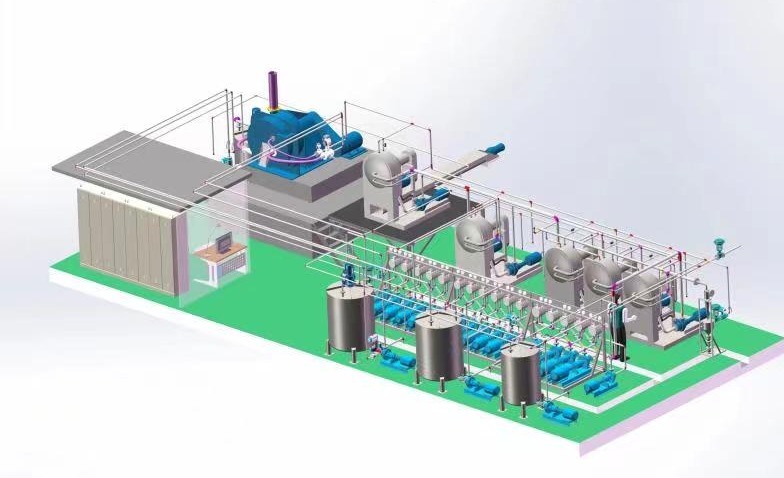

What aspects are involved in the infrastructure construction of starch production lines?
The infrastructure construction of the starch factory involves multiple systematic and professional projects, covering all aspects from raw material processing to finished product delivery. The following is a classification description of the main projects:
1. Plant planning and civil engineering
Site leveling and layout: including factory roads, drainage ditches, fences, greening, etc.
Factory construction: raw material warehouse, production workshop, finished product warehouse, packaging workshop, office area, etc.
Special structure: elevated storage tanks (such as starch slurry temporary storage tanks), sewage treatment tanks, fire-fighting facilities, etc.
2. Production core facilities
Raw material processing system:
Cleaning equipment (stone remover, drum cleaner)
Crushing and grinding equipment (hammer mill, needle mill)
Separation and refining system:
Centrifugal screen, cyclone group (used for starch, fiber and protein separation)
Dehydration equipment (vacuum filter, centrifugal dehydrator)
Drying system:
Air flow drying tower or flash dryer
Cooling and screening equipment (vibrating screen, pre-packaging treatment)
By-product disposal:
Protein recycling equipment (e.g. gluten concentration)
Fiber dryer (for feed by-products)
3. auxiliary production facilities
Water treatment system:
Process water purification (reverse osmosis equipment)
Circulating cooling tower (to cool the drying system)
Energy supply:
Boiler room (steam is provided for drying and sterilization)
Power system (transformers, backup generators)
Automated control:
PLC/DCS control system (monitors pH, temperature, flow and other parameters)
4. Environmental protection and waste treatment
Sewage treatment station:
Sedimentation tank, anaerobic reactor (treatment of high COD wastewater)
Sludge dehydrator (reduces the volume of solid waste)
Waste gas treatment:
Dust remover (drying process tail gas treatment)
Deodorization device (fermentation by-product area)
Solid waste utilization:
Potato residue/corn residue feed production line
Biogas digester (using organic wastewater to produce biogas)
5. warehousing and logistics
Raw material warehousing:
Potato/grain constant temperature storage (anti-mildew)
Silos (for granular raw materials such as corn)
Finished product warehousing:
Ton bag packaging area, palletizing robot
Moisture-proof and temperature-controlled warehouse (starch is easy to absorb moisture)
Loading and unloading facilities:
Truck platform, belt conveyor
6. public facilities
Fire protection system: sprinkler device, fire protection pool (starch dust is flammable).
Quality inspection laboratory: Test starch whiteness, viscosity, moisture and other indicators.
Staff facilities: locker room, shower room (meet food hygiene requirements).
7. Special needs projects
Energy-saving design: Waste heat recovery system (such as dry tail heat reuse).
Expansion reservation: Reserve production line space or pipeline interfaces.
key considerations
Explosion-proof design: Starch workshops must comply with explosion-proof electrical standards (such as ATEX).
Hygiene standards: Comply with FDA or ISO 22000 (international certification is required for export).
Degree of automation: Modern starch factories often adopt fully enclosed pipeline production to reduce manual intervention.
The specific configuration will be adjusted depending on the raw materials (corn, cassava, potatoes, etc.) and product types (raw starch, modified starch). It is recommended to cooperate with professional engineering companies during the planning and design stage to ensure compliance with local environmental protection and safety regulations.
Soaking process for corn starch
The cassava starch production line includes a special step: dry cleaning
Related Article